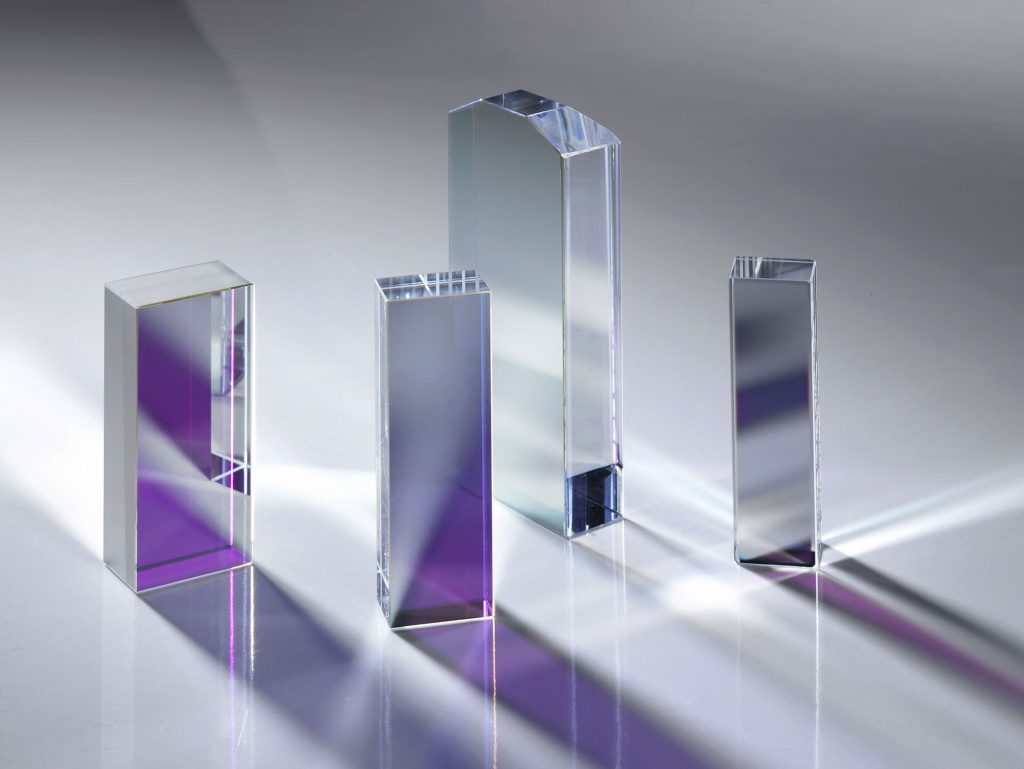
Polarizing Dichroic Beamsplitters
Polarizing Dichroic Beamsplitters Series

FAQs
Plate beamsplitters are flat glass substrates with a single coated surface. They generally have higher stray light and can produce ghost images due to double reflections, making them suitable for basic beam splitting in low-power systems.
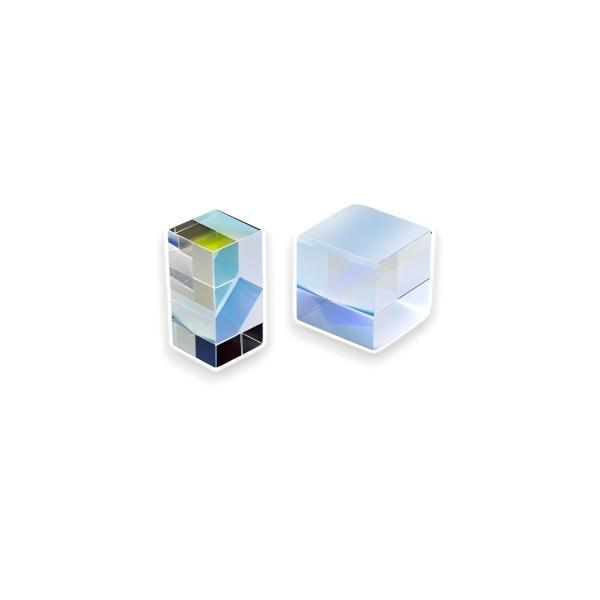
Cube beamsplitters consist of two right-angle prisms cemented together, with the beamsplitting coating protected at the internal interface. This structure greatly reduces stray light and is ideal for polarization control, laser systems, and precision instruments.
A polarizing beamsplitter uses multilayer dielectric coatings to achieve >99% reflection of S-polarized light and >95% transmission of P-polarized light at a 45° angle of incidence. It is typically used for polarization beam combining/splitting or for separating S and P components in reflected/transmitted light from a sample.
A polarizing beamsplitter cube is composed of two high-precision right-angle prisms cemented together. A multilayer dielectric PBS (Polarizing Beam Splitter) coating is applied to the internal cemented surface to separate S and P polarization. All external surfaces are typically broadband AR coated to reduce reflection losses and enhance transmission.
Yes, beam splitter prisms can be used with laser sources, provided that the laser wavelength matches the design specifications, the power density is within limits, and the polarization state is compatible.
Coligh offers beam splitter cubes for multiple wavelength ranges depending on the application:
-
VIS: 420–680 nm
-
NIR: 620–1000 nm
-
SWIR: 900–1300 nm and 1200–1600 nm